Chicago legal reform group lambasts Cook County State’s Attorney Eileen O’Neill Burke in new report
The Chicago Appleseed Center for Fair Courts found that in Burke’s first 500 days in office, she has pursued policies that “present fewer checks on police power in prosecution and prevent wrongfully convicted people from seeking redress.”
by Dave Byrnes May 20, 2026
Share this article:
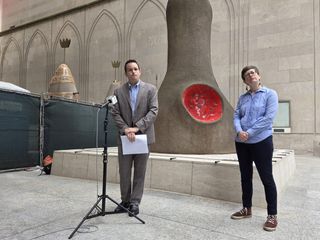
The progressive legal research nonprofit Chicago Appleseed Center for Fair Courts released a report on Wednesday which sharply criticized the policies of Cook County State’s Attorney Eileen O’Neill Burke.
Titled “500 Days Forward, 10 Years Back,” the report analyzed Burke’s tenure since she took office on December 2, 2024. Chicago Appleseed authors critically evaluated her office’s policies in the handling of pretrial detention, case diversion and sentencing, and police accountability—as well as the office’s response to violence against residents at the hands of federal immigration agents.
“By reducing checks on the police, allowing federal agents to commit state crimes without facing charges and creating roadblocks for people who have been wrongfully convicted, the Burke administration is exposing Cook County residents to abuse and unfair criminal outcomes,” Austin Segal, one of the report’s authors, said at a press conference on Wednesday.
Segal and other researchers concluded Burke has “radically redirected the priorities and orientation” of the state’s attorney’s office in a regressive fashion, “up-charging” people with felony retail theft along with axing lists of cops with questionable histories. The report was bookended with nine recommendations for the Cook County State’s Attorney’s Office (CCSAO), and three for the Illinois General Assembly (IGA).
“Eileen O’Neill Burke’s first 500 days as Cook County State’s Attorney reflect a departure from the previous administration’s reform orientation and a shift toward tough prosecution and deference to law enforcement,” the authors wrote.
For Burke, recommendations were made to reverse course on retail theft felony thresholds, blanket detention, felony review for gun possession charges, and police do-not-call lists. The report also urged expanded gun charge diversion program access, investigation and prosecution of federal immigration agents’ misconduct, and for increased accessibility of public data related to cases.
The researchers found that during Burke’s first year in office, county prosecutors requested pretrial detention in 51% of gun possession cases, more than double the rate they did during the last year Burke’s predecessor Kim Foxx was in office. This was despite the state’s attorney’s office handling slightly fewer unlawful gun possession cases overall during Burke’s first year compared to Foxx’s last.
Researchers noted a similar trend regarding domestic violence cases. The state’s attorney’s office handled slightly more domestic-related battery cases during Burke’s first year than during Foxx’s last, but under Burke, the rate of petitions to detain for this class of case doubled. Simultaneously, survivor advocates have called for her office to drop murder charges filed against Keshia Golden, who says she fatally stabbed her boyfriend Calvin Sidney while pregnant because she feared for her life after months of escalating abuse.
Per the report, retail theft cases in Cook County charged as felonies doubled between 2024 and 2025, jumping from 18% of cases to 36%; the percentage of retail theft convictions resulting in prison sentences jumped from 3% to 7% from 2024 to 2025.
On her first day in office, Burke directed prosecutors to seek felony retail theft charges when the value of allegedly stolen goods exceeds $300. In a reversal of reforms enacted by Kim Foxx during her tenure, Illinois now has the second lowest threshold for felony shoplifting in the nation.
Burke pledged on her first day that, in the name of public safety, her office would seek increased levels of pretrial detention “for the highest classes of violent offenses, all violent offenses that occur on public transit, any offense that involves the possession or use of an assault weapon, as well as numerous domestic violence/sex offenses and crimes against children has prioritized cases involving retail theft, gun possession and domestic violence.”
Citing that pledge, critics have accused Burke of violating the spirit of the Pretrial Fairness Act, which abolished cash bail in Illinois and sought to reduce the numbers of people incarcerated ahead of their trials. Under the act, part of the larger SAFE-T Act signed into law in February 2021, prosecutors petition judges to grant pretrial detention in cases where they believe it is warranted.
The Chicago Appleseed researchers echoed other Burke critics in their report by arguing county prosecutors are now instead seeking detention in a “blanket manner based solely on the alleged offense.”
Between Burke’s first day in office and time of writing, the Cook County Jail population has risen from 5,245 people to 5,677. Even accounting for daily fluctuations in the numbers of jailed people in Cook County, the average daily population in Cook County Jail as of May 15 stood 4.8% above where it was when the landmark Pretrial Fairness Act took effect in September 2023.
The rising jail population is not disconnected from Burke’s policies.
Loyola University researchers found in a study published last October that “almost all” the increase in the Cook County jail population from the start of 2024 through mid-2025 had been due to increased jail admissions. According to researchers, roughly 41 percent of those increased admissions were attributable to the Cook County State’s Attorney’s Office filing more pretrial detention petitions—and to judges increasingly granting them.
The authors urged the IGA to pass legislation which would increase the retail theft felony threshold, allow judges to bypass the CCSAO’s consent in placing people in diversionary programming, and protect provisions of the Pretrial Fairness Act.
On police accountability
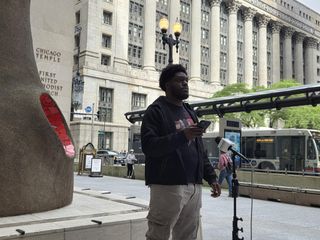
The Appleseed authors also criticized Burke on her office’s efforts to bypass the felony review process.
Felony review refers to how prosecutors review charges when a person is arrested for an alleged felony crime. Burke’s office launched a pilot program with the Chicago Police Department in January 2025 that allows officers to directly file certain felony gun charges without waiting for this prosecutorial review. Researchers warn this “expedited felony review” (EFR) program may have breached the limits initially set for it.
“Alarmingly, the data suggest that the CPD has bypassed felony review for felony gun offenses that should not be eligible for the expedited felony review policy according to the CCSAO,” they wrote. “There have been two counts of unlawful possession of a weapon by a repeat felony offender and three counts of aggravated discharge of a firearm filed through EFR, even though neither is one of the three charges the CCSAO included in their releases for this policy.”
The authors further argue this program removes a measure of accountability from the Chicago police, a law enforcement agency with such a sordid history of abuse that in 2019 it was subjected to a federal consent decree mandating reforms.
“More surveillance, policing. Politicians call it being ‘tough on crime,’ or ‘tough on guns,’” Malik Cole with the firearm harm reduction group Stick Talk said during Wednesday’s press conference. “But many communities, especially Black and brown communities, have been living with the results of police policy for years. And the truth is, punishment alone did not make people feel safe in their communities.”
Felony review is not the only police accountability issue the authors raised.
Under Burke, the office has also slashed do-not-call lists of cops with a history of dishonesty or misconduct, researchers concluded. The office now maintains only a single unpublished list of police who have been stripped of their authority.
The Cook County State’s Attorney’s Office instituted a “Brady Giglio Policy” before Burke took office wherein it maintained a “disclosure list” of individuals “subject to disclosure due to potentially impeaching material,” and a more damning “do not call list” of those who “shall not be called as witnesses in any proceeding.” This “do not call” list included over 280 names, including police officers, by November 2024. Burke’s office overrode the earlier Brady Giglio Policy in March 2025.
The Supreme Court cases Brady v. Maryland and Giglio v. United States helped establish due process rules requiring prosecutors to present all material evidence to juries and disclose evidence in criminal proceedings which could benefit defendants.
“By maintaining a less comprehensive list of discredited witnesses and being less proactive in collecting evidence on police witnesses, the CCSAO might actually be failing to meet its responsibilities under Brady and Giglio,” researchers wrote.
A special prosecutor
Adding to their points on police accountability, the authors argued Burke “has failed” to investigate and prosecute Immigration and Customs Enforcement (ICE) and other federal agents over their own violent actions.
In February, Burke’s office issued a protocol stating it will review evidence of federal agents’ misconduct brought to it by other law enforcement agencies. The protocol, however, also makes clear Cook County state’s attorneys will not serve as primary investigators in such cases.
The Hennepin County Attorney’s Office in Minnesota has taken a different track. Just this week, the office announced charges against ICE agent Christian Castro for allegedly shooting Minneapolis resident Julio Sosa-Celis in January. On April 16, Hennepin County Attorney Mary Moriarty also announced charges against Agent Gregory Donnell Morgan Jr. for allegedly pointing his gun at a driver on the freeway.
In New York, Attorney General Letitia James said in April her office was “continuing our review of the circumstances and treatment” that lead to the death of Nurul Amin Shah Alam, a near-blind Rohingya refugee who Border Patrol agents abandoned at night in front of a Buffalo coffee shop. Medical examiners deemed his death a homicide caused by “complications of a perforated duodenal ulcer precipitated by hypothermia and dehydration.”
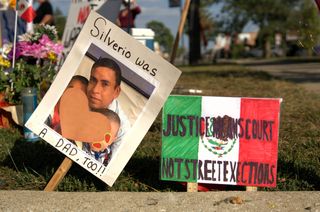
The Illinois State Police announced they had launched an investigation into the killing of Silverio Villegas González only several weeks ago—nearly eight months after an ICE agent fatally shot him in the Chicago suburb of Franklin Park last September.
Burke’s office told the Chicago Sun-Times that prosecutors will play a “supportive role” in the investigation.
“The office’s inaction in the months since Operation Midway Blitz began has actually led a group of government officials, community members and the law firm Loevy & Loevy to call for the appointment of a special prosecutor to investigate and prosecute [federal agents’] crimes,” Segal said Wednesday.
He referred to the coalition of over 430 elected officials, media organizations, advocacy groups, clergy and individuals who have signed a petition in Cook County Court seeking to appoint an independent special prosecutor to investigate the federal agents amid Burke’s own reluctance to do so.
Burke has fought the initiative in court. She said her office lacks statutory authority to lead investigations into criminal conduct, and that “[her] office’s goal is not to merely charge, but to successfully prosecute and convict criminal ICE agents.”
The Chicago Appleseed authors, however, say it’s “another example of Burke deferring to police, who have demonstrated little initiative to investigate misconduct and violence committed by federal agents, in lieu of using her own discretion.”
Dominic Guanzon contributed to this reporting.
Related Stories
-

In plain sight: a year of ICE using Chicago police parking lots for its operations
Videos and witness testimony show immigration agents continue using Chicago police station parking lots despite a ban on their access to city property. Records obtained from the Civilian Office of Police Accountability show the office has received at least seven complaints over ICE using police property since March.
-

Growing where he died: Silverio Villegas González, one year later
One year on from the killing of Silverio Villegas González, a community of Franklin Park women continue the fight to keep his memory alive–through art, flowers, and “a culture of celebrating life.”
-
Civilian oversight blues: inside Chicago’s ongoing police accountability meltdown
Chicago has a new community police oversight body that emerged in response to the historic 2020 protests. According to those elected to serve, however, it’s already full of cops.