“Please don’t let his case be forgotten”—families of murder victims say CPD is ghosting them
Supporters and families of victims attended Thursday’s Community Commission for Public Safety and Accountability meeting to demand answers.
by Zoë Takaki May 1, 2026
Share this article:
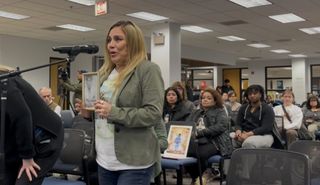
Mothers, fathers, and children of murder victims filled the Community Commission for Public Safety and Accountability (CCPSA) monthly meeting at DePaul College Prep on Thursday night to voice their concerns over the lack of communication they have received from the Chicago Police Department (CPD) regarding their loved one’s cases.
The meeting featured a panel of experts to discuss how Chicago supports survivors of violent crime and where gaps exist today.
Amalia Barrera was in attendance to express her frustration at the lack of communication and progress from police detectives in the investigation of the death of her 23-year-old son, Antonio Barrera, who was shot and killed in Rogers Park in February 2023.
Barrera explained that CPD has often kept her on hold for prolonged periods of time and scheduled appointments with her months in advance, only to tell her that they had no updates.
“I’m here because the police have not done anything about it,” said Barrera.
Maria Puga echoed a similar experience. Since her son Kobe Puga’s murder on October 14, 2023, she says police have only talked to her twice about his case.
Puga asked a sergeant to replace the detective in her case because she felt the detective assigned was not doing their job, but she was told they could not switch out the detective because they were “doing their job.”
She shared a story about one meeting with detectives where she felt pressured to give over her son’s phone to the police—which Puga felt was her last “tangible” connection to her son. She said she refused, fearing that she would not be able to get the phone back once she handed it over.
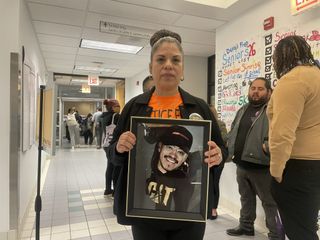
According to Puga—and corroborated by Rosemarie Dominguez, district councilor for the 10th District, who was with Puga in her meeting with detectives—police tried to use the phone as leverage, alleging detectives told her, “You give us the phone, and we will give you information.”
She says that the lack of responsiveness erodes her, and other families’, trust in the police department.
“I don’t even believe in justice anymore,” she said.
Puga’s experience mirrors that of the family of 22-year-old Marcela Herrera who was killed in a hit-and-run in Pilsen in July 2025. The case remains unsolved and her friends and family say they have been ghosted by detectives. Hundreds of supporters marched through the streets of Pilsen last month to demand answers from CPD.
Puga said she feels a discrepancy between how Chicago police prioritize murder cases based on race.
“For white people, there really is justice. They kill someone, and they find the killer right away. But what about us, those of us with Hispanic children?” she asked.
Brenda Castro, mother of Juan Castro Jr., who was killed three years ago, felt similarly, saying “I feel like we’re not getting treated the same way. I feel we’re all human beings, no matter what race you’re coming from.”
“Please don’t let his case be forgotten,” she begged the commission.
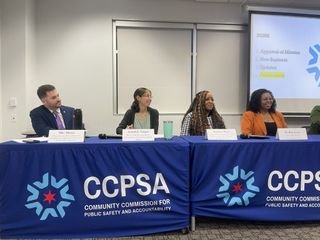
The panel convened by CCPSA included Mike Milstein, Deputy Director of the Office of Equity Management and Office of Victims Services for CPD, Amanda L. Vasquez, Research Manager with Illinois Criminal Justice Information Authority, Stephaney Harris, Victim Services Lead at the Mayor’s Office of Community Safety, and Dr. Blaire Lewis, Advocate Health Care Trauma Recovery Center.
CPD’s Office of Victim Services is intended to provide supportive services to survivors of domestic violence, gender-based violence, and gun crimes. These services include advocacy, crisis support, preparation for the justice system, safety planning, and referrals to resources like housing. The office is staffed by non-police, civilian specialists.
Advocates that work with survivors and victims families, however, have questioned whether an office within the Chicago Police Department can be effective. They have urged Mayor Brandon Johnson to reallocate CPD funds to support community-based organizations already supporting survivors.
Much of their panelists’ contribution to the conversation revolved around how to improve victims services through better access to services, training more victim advocates, and assuring informed consent to victims.
Dr. Lewis of the Advocate Health Care Trauma Recovery Center shared her organization provides free services to survivors of violence that does not require documentation for legal status.
The concerns voiced by families at the meeting are supported by data. According to the City of Chicago Office of Inspector General’s public safety dashboard, over the past twelve months, CPD had a clearance rate of 67.3% for homicide cases.
The clearance rate, however, is not an accurate reflection of how many recent cases were solved by CPD. The rate includes any case that was closed in the past year, no matter how long ago the crime was committed or why the case was closed. Some cases are closed because they were prosecuted, while others may be abandoned.
Clearance numbers also differ by race. A report from Live Free Illinois shows that in 2021 the homicide clearance rate by prosecution was 21.7% in predominantly Black neighborhoods and 45.6% in predominantly White neighborhoods.
The panelists did not discuss the investigation process for crimes, nor did they address the lack of responsiveness from CPD detectives alleged by families.
When asked if there is a timeline set in place for how long CPD have to respond to victims and their families, Milstein said he could not answer for the detectives, but said the Office of Victims Services is required by policy to have a victim specialist reach out to a victim within 72 business hours after an incident occurs.
Milstein acknowledged that they do not meet that response time 100% of the time, however, he hopes they can get closer to that goal after 15 new hires start on May 1.
Related Stories
-
In plain sight: a year of ICE using Chicago police parking lots for its operations
Videos and witness testimony show immigration agents continue using Chicago police station parking lots despite a ban on their access to city property. Records obtained from the Civilian Office of Police Accountability show the office has received at least seven complaints over ICE using police property since March.
-
Growing where he died: Silverio Villegas González, one year later
One year on from the killing of Silverio Villegas González, a community of Franklin Park women continue the fight to keep his memory alive–through art, flowers, and “a culture of celebrating life.”
-
Civilian oversight blues: inside Chicago’s ongoing police accountability meltdown
Chicago has a new community police oversight body that emerged in response to the historic 2020 protests. According to those elected to serve, however, it’s already full of cops.