“Urgency was left in the dust long ago”—few answers from Chicago police superintendent on department collaboration with ICE
Chicago Police Superintendent Larry Snelling defended his officers’ actions amid the Trump Administration’s mass deportation campaign in Chicago, waving off community criticism as people not having an “open mind.”
by Dave Byrnes Apr 3, 2026
Share this article:
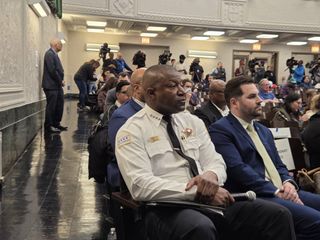
Dozens of Chicagoans turned out to Thomas Kelly High School on a stormy Thursday night to hear Superintendent Snelling answer questions from the city’s Community Commission for Public Safety and Accountability (CCPSA) about cooperation between Chicago Police Department (CPD) officers and federal immigration agents.
For about forty minutes, Snelling sat with commissioners on the school’s auditorium stage and fielded the commissioners’ questions about CPD officers’ behavior during Midway Blitz, how they ought to respond to a federal immigration agent violating state law, and how community members can report police who appear to assist federal agents with immigration enforcement.
The meeting was a long time coming. On January 8, the Community Commission for Public Safety and Accountability (CCPSA) held a special meeting to hear residents’ accounts of violence and potential violations of so-called “sanctuary” laws, after a community petition demanding such a meeting gathered more than 2,000 signatures in 21 days. Both Chicago and Illinois have laws—the Welcoming City Ordinance and the Illinois TRUST Act, respectively—that theoretically bar local police from assisting federal agents with civil immigration enforcement.
But since last June, when CPD officers were first witnessed coordinating traffic and crowd control around an Immigration and Customs Enforcement (ICE) abduction at an immigration office in the South Loop, community members and local leaders have questioned whether CPD has violated those laws.
On February 26, CCPSA used their regular monthly meeting to invite leaders from the Civilian Office of Police Accountability, the Office of Inspector General, and Chicago Police Department to answer questions about how police have interacted with immigration agents. Snelling said he was unavailable to attend.
Thursday night’s special meeting was the public’s chance to finally hear Snelling answer questions about the issue. Block Club Chicago reported earlier this week that Snelling only agreed to attend if experts on immigration and police reform did not join the panel.
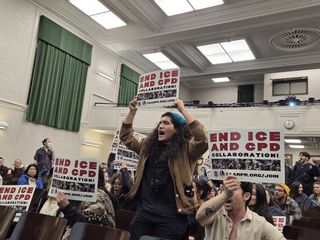
Throughout the meeting, Snelling defended Chicago police officers’ actions since last June, insisting CPD’s goal was to keep people safe through a fluid and unprecedentedly aggressive deportation campaign.
“I can guarantee you when [the Welcoming City Ordinance and the TRUST Act] were written, no one wrote the ordinance and the law with this type of immigration enforcement in mind,” Snelling said.
At one point, Snelling fielded questions from CCPSA commissioner Gina Piemonte over why CPD officers kept their backs to federal immigration agents during Midway Blitz at times when communities confronted the agents and CPD formed perimeters around them. He responded that CPD sought to prevent “a clash” between agents and the community—on whom he placed the blame for potential escalation.
“We’re trained to watch those who are posing a threat that would lead to a higher level of force from agents,” Snelling said.
Snelling also argued, in response to questions from commissioner Abierre Minor, that there would be times when it would “look like” CPD was collaborating with federal immigration agents during chaotic situations, when they were actually trying to diffuse the situation.
“We try to get those federal agents off the scene as quickly as possible because we know the longer they stay there, the more emotions continue to rise,” Snelling said.
He specifically referenced the shooting of Marimar Martinez in October, and the community protest which sprung up in response, less than a mile from Thomas Kelly High School. In that incident, Chicago police formed a barrier around armed federal immigration agents, facing the crowd.
When the agents finally left the scene of Martinez’s shooting, they tear gassed the community and CPD officers alike.
When heckled by meeting attendees over his answers, Snelling addressed them directly.
“You don’t have the experience or the knowledge to understand why we wouldn’t face the ICE agents,” Snelling said.
Snelling remained on the defensive for much of the meeting, beginning with a public comment period where speakers chewed out both him and the CCPSA commissioners.
Unlike the January special meeting where dozens of people offered public comment, on Thursday the commission limited public comment to ten speakers. Nearly all of the speakers criticized CPD for what they believed was collaboration with federal agents and questioned why CPD had not conducted investigations into incidents of violence or property damage caused by ICE and Customs and Border Protection agents.
Chris Gentry, a U.S. Army military police veteran, wearing a “veterans against fascism” t-shirt, told a story of a federal agent pointing a gun and threatening him, in front of police.
“An ICE agent rolled his window down as they’re driving out of the discount mall, pointed a handgun out the window and said, bang, you’re gonna die… in front of a police officer,” Gentry said, addressing both the commission and Snelling.
At one point following public comment, Snelling chided meeting attendees after someone shouted at him to shut the fuck up.
“I’m sorry, how disrespectful are we gonna allow these people — ‘shut the what up?’ I mean, come on,” Snelling said, addressing both the crowd and commissioners.
The meeting ended after every commissioner present Thursday had a chance to ask Snelling a question. As soon as CCPSA President Remel Terry concluded the discussion, members of the crowd began to protest Snelling.
A chant eventually broke out of “CPD, KKK, ICE, they’re all the same!”
Chicago police officers moved to guard the stage while school staff gave the crowd two minutes to disperse before they were considered trespassing.
Snelling briefly spoke to the press after the crowd cleared out. He criticized meeting attendees for not “walking in with an open mind” about what he had to say. Community members themselves, including at least one member of Chicago’s police district councils, had a different takeaway.
“Commissioners can’t feel proud of themselves after that hearing. So disappointing,” 20th District Councilor Deirdre O’Connor said on social media after the meeting concluded.
Snelling also addressed an unconfirmed ICE arrest that reportedly occurred at the Cook County Domestic Violence Courthouse on Thursday.
The Illinois Court Access, Safety and Participation Act, which Governor JB Pritzker signed last October, bars civil arrests (e.g. immigration arrests without a judicial warrant) against people attending state court proceedings. When a reporter for Univision asked if Chicago police should respond to ICE agents apparently violating this state law to conduct an arrest at the domestic violence courthouse, Snelling incorrectly said such a law didn’t exist.
“There’s no law like that,” Snelling wrongly stated. “There’s no law that says that immigration enforcement can’t happen around particular locations. That’s not a law.”
The Department of Justice has sued Chicago and Illinois over the new law, but the law remains in effect. Both Snelling and other reporters in the press scrum seemed to confuse the new law with the Illinois TRUST Act, which Snelling correctly noted does not compel Illinois law enforcement to interfere with immigration arrests.
Besides Snelling’s comments, the commission also voted Thursday to recommend Chicago’s Deputy Inspector General for Public Safety open an audit over CPD’s implementation of the Welcoming City Ordinance. Only commissioner Sandra Wortham voted against making the recommendation.
Thursday’s meeting occurred during the Jewish observation of Passover and the Christian feast of Holy Thursday. Terry acknowledged the complications this presented for people of faith who wished to attend the meeting, but said the commission wanted to ensure the meeting with Supt. Snelling went forward “with urgency.”
Public commenter Delaney Bonacquisti disputed Terry’s assessment.
“I don’t countenance your statement that this had to happen with urgency,” she said. “It was an eight month delay between the June 4 incident of collaboration with CPD and ICE. It’s been three months since the last meeting. Urgency was left in the dust long ago.”
Related Stories
-
“Pressure, influence, and intimidation”—house call by former Chicago cop sparks dispute among police oversight officials
Retired Chicago police sergeant Lee Bielecki’s snooping at the home of a member of the Community Commission for Public Safety and Accountability is part of a pattern of intimidation and attempts to influence the nomination process for the commission, activists and police district councilors say.
-
Border Patrol agents ignored orders to end car chase before gassing Chicago neighborhood
DHS claimed federal agents intentionally hit a fleeing vehicle to try to stop the driver in Chicago’s East Side neighborhood last October—but videos of the 18-minute high-speed pursuit show they actually blew a tire and crashed after ignoring a supervisor’s commands to end the chase.
-
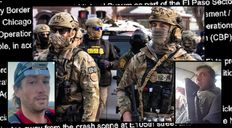
Identified: the El Paso BORTAC crew rampaging through the Midwest
One violent duo in particular, U.S. Border Patrol agents Michael Sveum (EZ-2) and Edgar Vazquez (EZ-17), have been frequently seen alongside former commander-at-large Greg Bovino terrorizing crowds with chemical weapons in Chicago and the Twin Cities.