Support Unraveled
Your support funds our investigative and on-the-ground reporting. Thank you for uplifting independent journalism!
SupportVideos show federal agents pointing weapons at bystanders and trying to access state property as rapid response groups have reported at least 80 detainments across Chicagoland in the last five weeks.
by Dave Byrnes | Dominic Guanzon | Zoë Takaki Jun 15, 2026
Share this article:
CONTENT WARNING: Images and descriptions of police violence.
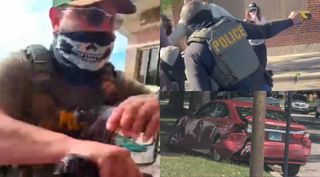
Federal immigration agents caused a car crash on June 9—their second in just one week.
Both crashes coincide with a visible spike in Immigration and Customs Enforcement (ICE) activity after a winter respite. Federal agents have returned to more covert street arrest tactics and so-called “targeted enforcement” as rapid responders, plate watchers, and other volunteers continue to battle a siege made mundane after the departure of the flashier Customs and Border Protection (CBP) sweeps that characterized last fall’s “Operation Midway Blitz.”
According to video footage of the June 9 crash shared with Unraveled, federal agents driving an unmarked SUV struck a red sedan from behind at high speed in Chicago’s far Northwest Side neighborhood of Dunning.
Earlier today rapid responders reported federal agents detaining someone on Grace & Olcott in Chicago. A nearby resident got video of an unmarked SUV striking a red car at high speed in the residential area around 10:24 am. He then described seeing men in tactical vests on scene, one marked "ICE."
— unraveled (@unraveledpress.com) June 9, 2026 at 2:57 PM
[image or embed]
Local resident Edward Krueger captured the incident on his home security camera. It appears to show an attempt at a PIT (precision immobilization technique) maneuver—an intentional, dangerous crash tactic police employ to stop a fleeing vehicle. Last October, ICE agents used the technique on Chicago’s Southeast Side, despite a supervisor’s order to abandon their pursuit. In Illinois, such maneuvers qualify as use of deadly force.
“It’s a little disheartening to see some sort of federal agent or law enforcement agent driving in such an aggressive way in a residential area,” Krueger said. “I have a kid…we go out for walks sometimes. We could have been crossing the street when they flew through the intersection.”
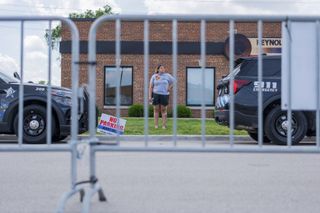
The Department of Homeland Security (DHS) later confirmed they were carrying out a “targeted enforcement operation” and detained a man born in Poland after the crash. ICE held him at the ICE “processing” facility in Broadview for only a few hours before he was moved to the Miami Correctional Center in Bunker Hill, Indiana.
One week earlier, almost to the hour, federal agents also struck another occupied vehicle in Albany Park, the heart of several Chicago immigrant communities. In that June 2 crash, agents tased the man they abducted; they also pushed and pointed a taser at the crowd of onlookers who gathered at the scene.
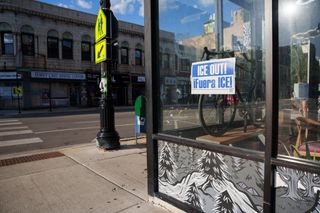
One rapid responder and organizer, identified anonymously as “J,” lauded community members for their quick response that day.
“There was graduations happening at the schools here on the corner, and the chaos that ensued,” J said. “And also, just seeing how many people were ready and came out. But yeah, he was taken.”
Allison Galvan, co-founder of the ICE detention rapid response and mutual aid group Grito Latino Addison, told Unraveled she’s also seen a sharp increase in activity across the near suburbs.
“Everyone was saying that, you know, ICE was gone, you know, January, February, March, because, you know there was not really activity for some people, or people were not paying attention because all eyes were on Minnesota,” Galvan said “But ICE never really left.”
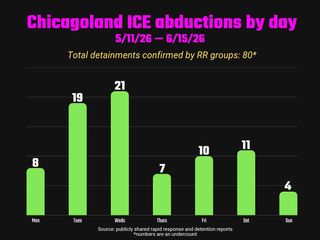
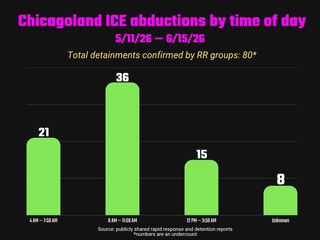
Federal agents have detained at least 80 people in Chicagoland—38 in Chicago, and 42 in the suburbs—between May 11 and June 15, according to reports verified by volunteer rapid response groups.
Unraveled is collating abduction reports publicly shared to social media pages; given federal agents’ return to swifter, more covert arrests, totals reported by volunteers almost certainly represent but a fraction of immigrants taken.
“I would say every day…I’ll see reports come through of people saying, ‘this wasn’t called in, or wasn’t reported yesterday, but since then I learned that this happened in Romeoville or, you know, west Humboldt Park,’” J said. “So I would imagine that there are then cases that we have just no idea about at all.”
According to findings by the Deportation Data Project, 580 people in Chicagoland were detained between January 1 and mid-March, as reported by the Chicago Sun-Times. The Deportation Data Project sources its numbers directly from ICE via a public records inquiry.
18-year-old Ben Luhmann responds to ICE activity in the far west suburbs. He told Unraveled ICE activity “seemed to calm down after [Minneapolis Operation] Metro Surge.”
“But now…we’ve seen it very much pick up in the last two months,” he said.
Over the tracked five week period, federal agents detained most people on Wednesdays (21). Of the 80 people confirmed detained, 57 were taken during morning hours.
In Chicago proper, the West Side saw the highest number of people taken at 16, followed by the Far North Side at eight. Outside the city, federal agents were most busy in suburban Cook County, with 19 confirmed detainments. There were 10 people confirmed taken in DuPage County, and another five in Lake and Kane Counties, respectively.
“They go in and out of the parking lots, and as soon as you show up and start filming, usually they move, they’ll do a loop and then they’ll come back,” Luhmann said. He and his brother use their phones and wear body cameras while patrolling to keep track of agents’ movements, which can turn violent quickly. “If a simple camera and us giving any sense of accountability to them makes them leave, then they’re not doing it the right way.”
The weapon pointing documented in recent weeks follows a fall that saw multiple violent scenes sparked by federal agents.
Last September, a yet-unidentified ICE agent killed 38-year-old Mexican citizen Silverio Villegas González during what was described by the Department of Homeland Security (DHS) as a “vehicle stop.” Villegas González crashed into a parked box truck after being shot behind the wheel of his car.
Only a few weeks later, on October 4, Border Patrol agent Charles Exum swerved his vehicle into Chicago resident Marimar Martinez’s. Exum then shot Martinez five times, later bragging about it in text messages that were made public amid the federal government’s failed attempt to prosecute Martinez for assaulting an agent. And in Evanston last Halloween, U.S. Border Patrol agents Thomas Parsons and Timothy Donahue respectively punched a handcuffed person on the ground in the back of the head and pointed a gun at bystanders—amid yet another car crash.
On May 25, while detaining a person in Joliet, an agent raised what appeared to be a handgun toward a person filming them from inside a home.
“What are you doing?” a person in the home shouted, as the agent lowered the weapon and stepped out of frame. A few seconds later in the video, which was shared on social media, a small child is visible.
Since late winter, federal agents have also been repeatedly observed staking out courthouses across northern Illinois, frequently visiting the Cook County Domestic Violence Court in downtown Chicago. According to internal documents obtained by Unraveled, one agent even told Cook County Sheriffs in May that he was “conducting surveillance” at the courthouse.
Arrests have been confirmed outside judicial buildings that lie in close proximity to police departments and other state property. For instance, the Pullman and Grand & Central courts both share building space with the Chicago Police Department. The Leighton Criminal Courthouse sits adjacent to Cook County Jail, while the Domestic Violence Court sits across the street from the United States Custom House in Chicago.
Last month, the Cook County Public Defender’s Office told Unraveled that federal agents had detained at least 13 people across more than two dozen courthouse-related incidents between February 27 and May 8. As of June 9, the public defenders report the number of court-related detainments since late February has swelled to at least 26 people across 50 incidents.
Your support funds our investigative and on-the-ground reporting. Thank you for uplifting independent journalism!
SupportIn December, Illinois Governor JB Pritzker signed the Court Access, Safety, and Participation Act (CASPA), which is designed to protect people from immigration arrest inside or in transit to and from state courthouses. The legislation, which the Trump administration is currently challenging in federal court, entitles those affected by a violation to $10,000 in damages. But Illinois Attorney General Kwame Raoul’s office conceded in a February court filing that CASPA “does not task the Governor or Attorney General with any enforcement authority.”
Galvan told Unraveled the people she assists have been more frequently requesting remote court appearances to avoid ICE. On May 7, the same day federal agents were spotted at four separate Cook County courthouses, the office of Cook County Chief Judge Charles Beach issued an announcement instructing the public on how they can appear in court remotely.
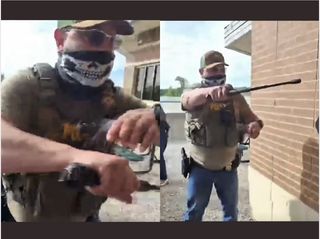
On May 31, agents detained two more people being released from the Kane County Jail. One agent wearing a face mask emblazoned with the image of a skull—a covering often associated with far-right extremism—brandished a baton at community members heckling and filming.
Via Freedom of Information Act (FOIA) request, Unraveled obtained video footage of the Kane County Sheriff’s Office’s foyer on the morning of May 31. A masked ICE agent can be seen attempting to enter the office proper, then turning away after finding the door locked:
Kane County State’s Attorney Jamie Mosser and Undersheriff Amy Johnson denied any coordination between the sheriff’s office and the federal agents on May 31, saying the two men arrested “were being released from the jail and were serving sentences of periodic imprisonment, a sentence that allows them to fulfill their jail time exclusively on weekends.”
The Kane County Sheriff’s Office keeps a publicly accessible record of people detained in the county, along with their anticipated date of release when applicable.
“Illinois law does not stop agents from viewing public court records and jail records, nor does it stop agents from entering public spaces like the courthouse parking lot,” Mosser said in a June 3 statement.
Onlookers videotaped the same skull-masked ICE agent who brandished a baton on May 31, breaking a person’s car window during another detainment outside the Kane County Judicial Center on June 15. The judicial center shares grounds with the county sheriff’s office.
Immigration court has also become more difficult for people to navigate.
In late May, the National Immigrant Justice Center (NIJC) announced that immigration courts in multiple cities, including Chicago, had begun holding “mass” preliminary hearings “in which groups of about 30 or more people, many without lawyers, appeared together before a single judge and were pressured to expedite their removal proceedings.”
The NIJC further warned that such large hearings “creates significant room for error and due process violations, including the potential for people to unintentionally waive their rights to fight deportation.”
Unraveled observed these mass preliminary hearings firsthand on June 10. Over one hundred people were assigned to a single court hearing in multiple courtrooms. 9 a.m. preliminary hearings saw 162 people scheduled to appear before Judge Michelle Venci and 202 people before Judge Joshua Luskin.
Court watcher Jack Lloyd has observed immigration proceedings for a decade. He told Unraveled most preliminary hearings consisted of 30 to 40 people before the recent changes.
He also highlighted how, since January 2025, the Trump administration has fired dozens of immigration judges, including in Chicago. Some of those fired, like former assistant chief judge Jennifer Peyton, granted asylum relief at notably higher rates than those that remain. Peyton granted asylum relief in about 88% of cases she reviewed between 2020 and 2025. The man who replaced her as assistant chief judge in Chicago, Craig DeFoe, granted asylum relief about 36% of the time within the same period.
Further into the deportation pipeline, hunger and labor strikes at immigration jails nationwide have erupted this spring.
Outside Los Angeles, hunger strikers at the Adelanto ICE Processing Center alleged retaliation and threats from GEO Group’s private prison guards. In April, hundreds of detainees at Michigan’s North Lake Processing Center, the largest in the Midwest, also organized hunger and work strikes to call attention to jail conditions. And In Newark, New Jersey’s, federal agents and local police have brutalized anti-deportation demonstrators at Delaney Hall Detention Facility for the past several weeks. Inside the facility, captives are protesting overcrowded, unsanitary conditions and alleged sexual abuse from staff.
The mass arrests of protesters outside Delaney Hall parallel events outside Broadview during Chicago’s autumn blitz. State and local police arrested over 100 people demonstrating outside the facility in 2025, according to officials with the National Lawyers Guild. Many cases have already been dismissed. Local police have arrested nearly two dozen more people since the start of 2026.
Federal lawmakers, meanwhile, continue to funnel money toward the Trump administration’s mass deportation campaign. Last Tuesday, Congress approved $70 billion in new funding for ICE and CBP through 2029. This adds to the some $191 billion earmarked for DHS in a 2025 budget reconciliation package, making it “the largest single package of DHS appropriations ever enacted.”
In the face of this cash influx, volunteers remain wary but determined.
“I just remember feeling completely exhausted and defeated,” Galvan said. “And then I remember that’s exactly what they want.”
Andres Alejandro Chavez contributed to this reporting.
Videos and witness testimony show immigration agents continue using Chicago police station parking lots despite a ban on their access to city property. Records obtained from the Civilian Office of Police Accountability show the office has received at least seven complaints over ICE using police property since March.

One year on from the killing of Silverio Villegas González, a community of Franklin Park women continue the fight to keep his memory alive–through art, flowers, and “a culture of celebrating life.”
Chicago has a new community police oversight body that emerged in response to the historic 2020 protests. According to those elected to serve, however, it’s already full of cops.