Growing where he died: Silverio Villegas González, one year later
One year on from the killing of Silverio Villegas González, a community of Franklin Park women continue the fight to keep his memory alive–through art, flowers, and “a culture of celebrating life.”
by Dominic Guanzon Sep 14, 2026
Share this article:
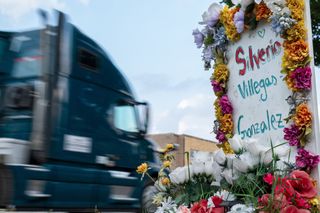
It can be hard to find a quiet moment where ICE agents killed someone.
At the intersection of Emerson Street and Grand Avenue in Franklin Park, trucks slingshot past so fast they cause your chest to vibrate.
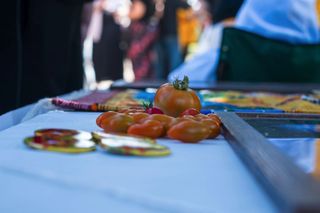
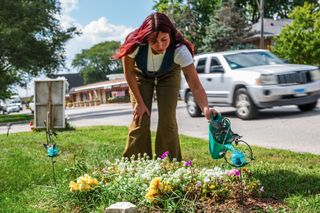
But just a dozen feet away from the traffic, a garden grows tall. A pair of women walk up to the roadside memorial with jugs of water and scissors to prune the tomato plant overflowing from a used tire-turned-planter. They are with a local group called Hijas Del Pueblo–Daughters of The People.
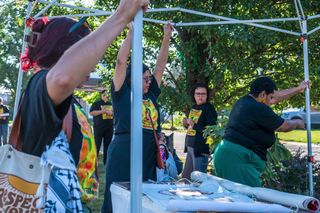
They and other volunteers arrived early on the morning of Saturday, September 12, to set up tents and an altar beside the memorial garden.
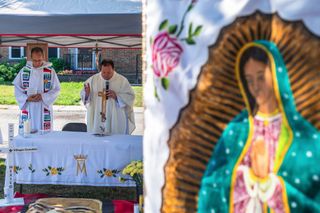
With tables set, community members gathered for a memorial mass Saturday morning on the side of the suburban stroad. One year prior, and only feet away, an Immigration and Customs Enforcement (ICE) agent shot and killed 38-year-old Silverio Villegas González, an immigrant from Mexico. It was the death that inaugurated “Operation Midway Blitz.”
“It’s a lot of mixed feelings,” María “Lupe” Gonzalez (no relation), co-founder of Hijas, explained. “I feel happy that the community showed up. Organizations and people who really care and don’t forget about Silverio and what happened here. But the other side is sad. We shouldn’t be doing this. He just dropped his kids off at the school, and after that, he was murdered.”
Father Brendan Curran, a Catholic priest who helped lead the mass, echoed the sentiment during his homily.
“This is not a good day. We should not be here,” he said, repeating his words in Spanish. “We find it hard today to gather in these spaces…where a homicide has taken place.”
After the memorial, local officials addressed the crowd, including Franklin Park Trustee Irene Avitia. She emphasized the town’s majority Hispanic population, and summarized the terror of one year ago.
“Our schools were placed on lockdown. Fear and anger began to spread among our families and neighbors…what happened during that reckless ICE apprehension put us all at risk,” she said.
Activists and elected officials have repeatedly demanded a federal investigation since Villegas González’s killing.
According to Avitia, however, Franklin Park officials “still have not received the results of the investigation conducted by the FBI and the Department of Homeland Security.”
The Illinois State Police opened an investigation of their own this past May after a state commission on Midway Blitz violence called for it. By the time of the anniversary service, a report had not been released.
Villegas González’s family released a statement to Unraveled through their attorneys prior to the memorial mass.
“As the family of Silverio Villegas González, a year after he was shot and killed, we want his name to be cleared,” the family said. “The administration has tried to justify his death by smearing his good name with lies and false narratives, but here is the truth: after Silverio was shot, two innocent children were left without their father, and we were left without a brother and son.”
The family is still considering its legal options against the federal government.
Jonathan Manes, an attorney with the MacArthur Justice Center, which is representing the family, described the federal government’s callousness toward Villegas González’s killing.
“I’m not optimistic [the Department of Homeland Security] will take this seriously because they didn’t take Silverio’s death seriously the day he was killed,” he told Unraveled. “It’s disgusting they’re using moments like this, the death of someone, as propaganda.”
A DHS statement released the day of the killing said “the alien resisted arrest,” and claimed Villegas González “drove his car at law enforcement officers,” which security camera footage disproves. The official statement also claimed the agent was “seriously injured,” but body-worn camera footage from responding Franklin Park police officers shows the ICE agents describing their injuries as “nothing major.”
A Garden On Grand Avenue

Weeks before the mass, Adriana Balvaneda, co-founder of Hijas Del Pueblo, arrived at the memorial with fellow member Ingrid. They put their purses down by a foot-tall lamp and got to work tending the soil.
“I tell people all the time, Franklin Park is a one mile by one mile town. [Grand Avenue] is the biggest road,” Balvaneda told Unraveled in August. “This road also leads you directly to Broadview [and its ICE facility] if you go 15 minutes down.”
The harvest of baby green tomatoes splayed out in all directions; a four foot tall mass of leaves and fruits towering over nearby flowers and basil plants in their own tires. Each is adorned with the name of someone killed by federal immigration enforcement in some way: Keith Porter Jr, Renée Nicole Good, Geraldo Lunas Campos.
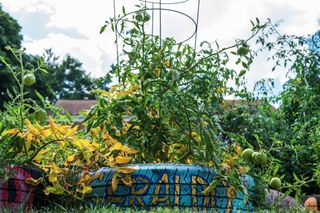
“A lot of us wanted to pretend like it didn’t affect us, but you can’t turn a blind eye when it’s literally on the one major road of your town.” Balvaneda said. “And then the other half of our town is just factory. We’re a really, really small community.”
Hijas Del Pueblo was founded in 2024 after Sangamon County Sheriff Sean Grayson killed Sonya Massey in Woodside Township, near the Illinois state capital of Springfield (Grayson died in August; his attorneys are now requesting the state vacate his second-degree murder conviction). After September 2025, law enforcement killings truly hit home.
As ICE killings have continued, organizers are honoring victims with flowers from their place of origin, including prairie anemone for Renée Nicole Good and California poppy for Keith Porter Jr. They planted marigolds for Villegas González.
“It’s a very spiritual flower in Mexico for the Day of the Dead. It is said its scent is meant to guide our spirits back home so they can visit loved ones,” Balvaneda said. “It’s really good for insects, so it also protects our tomatoes.”
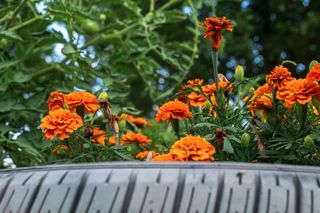
A Salvadorian immigrant, Ingrid said she has “learned a lot” about life during her time caring for the space.
“I’m not Mexican, but I think the Mexican culture sees death in kind of a beautiful way. Death and life coincide with each other, and the way they celebrate their dead is really beautiful to me. So this is a way for him to…keep reliving.”
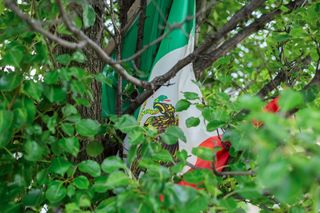
From a Mexican flag hanging from a nearby, to a public streaming playlist of Villegas González’s favorite music, there is pride sitting beside the sorrow.
“A lot of the women in the group are lovers of music, are lovers of art,” Balvaneda explained. “You can appreciate our culture, but you have to defend your culture.”
Fighting For A Community
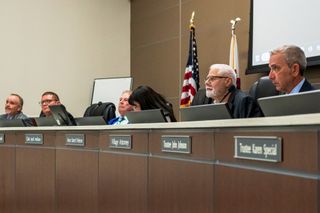
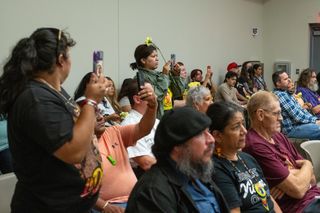
Last month, the Franklin Park Board of Trustees voted to install a memorial bench and plaque at Emerson and Grand as a permanent memorial to Villegas González after the community advocated for something official. The packed crowd welcomed the near-unanimous “yes” vote. Retired Franklin Park police officer and former FOP Lodge 47 President William “Bill” Ruhl voted “present.”
But despite the high spirits of that night’s crowd, Balvaneda still held onto frustration as she carried gardening supplies to and from her car.
“I’m mad because there’s no reason it should have been us. Why did it have to be the women of Franklin Park and the surrounding towns, who had to join forces to make that permanent?”
In the face of the tragedy, Hijas Del Pueblo have taken to organizing events, including a family play date on Labor Day, and an art pop-up after the mass.
Balvaneda hopes they can grow something out of the loss.
“The reason why a lot of the people in Franklin Park are not even that affected by Silverio…is because there is no culture here of celebrating life,” she said. “How can you understand death if you don’t even have a culture of celebrating life?”
“People don’t know how to build community,” she added. “They’re afraid of it.”
Lupe Gonzalez mirrored the sentiment during Saturday’s memorial service.
“The government wants to make us obsolete. They don’t want us to unify…to meet each other. So we have to build that community. All those small groups and big groups have to be united. Make events, do the support, go outside to the streets, and support the people who are suffering right now.”
ICE claims it has detained nearly 51,000 people across the country this past August alone. Since the start of the 2026 fiscal year, the United States government has deported over 350,000 people.
“I think we just see ourselves in him,” Ingrid said. “Like, this could have been any of us. We grew up here. This could have been my parents. So it’s just, I don’t know, a way to kind of grieve, mourn and turn it into something so beautiful.”
Dave Byrnes contributed to this reporting.
Related Stories
-
In plain sight: a year of ICE using Chicago police parking lots for its operations
Videos and witness testimony show immigration agents continue using Chicago police station parking lots despite a ban on their access to city property. Records obtained from the Civilian Office of Police Accountability show the office has received at least seven complaints over ICE using police property since March.
-

Civilian oversight blues: inside Chicago’s ongoing police accountability meltdown
Chicago has a new community police oversight body that emerged in response to the historic 2020 protests. According to those elected to serve, however, it’s already full of cops.
-
Chicago ICE team seen threatening drivers has roamed from Illinois to Minnesota to Virginia
A federal agent from Chicago identified by community members as 40-year-old Martin Lagunas was recorded pointing his gun in a Virginia woman’s face on Monday. His team of ICE agents has been documented intimidating observers, drivers, and protesters across at least three states in the last year.