Police accountability commission under fire: “You have state power—fucking use it.”
Chicagoans shared accounts of Chicago police helping ICE and Border Patrol agents at a public listening session they criticized as long overdue.
by Dave Byrnes and Steve Held Jan 9, 2026
Share this article:
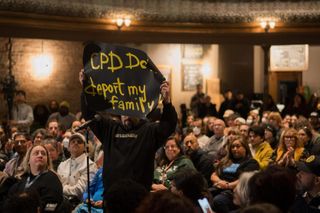
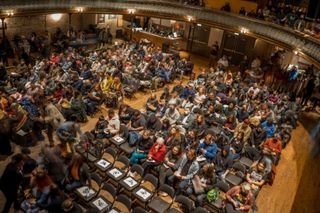
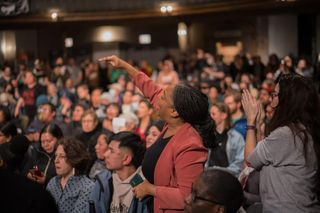
Hundreds of Chicago residents braved Thursday night’s torrential rain to gather for a special meeting of the Community Commission for Public Safety and Accountability (CCPSA).
The hearing was prompted by a community petition that gathered over 2,000 signatures over 21 days. District councilors from Chicago’s police district councils—22 elected councils across the city’s police districts—spoke with reporters before residents packed into Thalia Hall in Pilsen.
“This moment exists because the people demanded it,” said 7th District Councilor Dion McGill. “People have said that things have happened. We want to know the truth.”
Both Chicago and Illinois have so-called “sanctuary” laws that, in theory, bar local police from assisting federal agents with civil immigration enforcement. Dozens of community members, however, said they had witnessed collaboration between Chicago police and DHS agents on numerous occasions preceding and during Operation Midway Blitz.
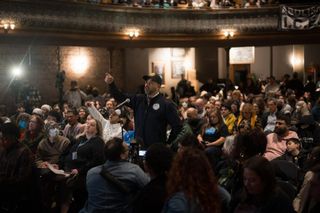
Most comments revolved around incidents where Chicago police established traffic perimeters or conducted crowd control around immigration agents’ activities. A speaker early on recounted one such incident on Halloween.
“What I witnessed that day was not only ICE, but unsurprisingly, CPD protecting and defending ICE agents while they kidnapped my neighbors,” they said. “They pushed and they shoved us, the protesters, away from the ICE agents, and allowed ICE to get away with their abuse of power.”
Maya Macias, who said she was born and raised in the Back of the Yards neighborhoods, said the community has lost any trust they might have had in CPD and described brutal conduct by CPD after an incident with Border Patrol in the Little Village neighborhood.
“Trust that might have existed once upon a time with the community in the Chicago Police Department is long gone,” Macias said. “When I arrived…ICE was not present. Yet, there were at least 70 officers on the scene creating chaos, shouting conflicting commands…In one instance, I counted up to 10 officers pushing one man to the ground, one man, one man to the ground, 10 officers.”
Thursday’s hearing came on the heels of the killing of 37-year-old Renee Good at the hands of Immigration & Customs Enforcement (ICE) Agent Jonathan Ross in Minneapolis, Minnesota. Ross shot and killed the young mother in her car on Wednesday morning, in front of her wife and witnesses. The killing echoes the circumstances surrounding another recent death at the hands of federal agents, that of 38-year-old Silverio Villegas González in September.
Just before the start of the meeting, U.S. Customs and Border Protection (CBP) agents shot two more people in Portland, Oregon. Both are hospitalized but their conditions have not been made public.
Speakers leaned on the commission itself—ostensibly a civilian check on Chicago police activities—to hold CPD to account as DHS violence intensifies nationwide.
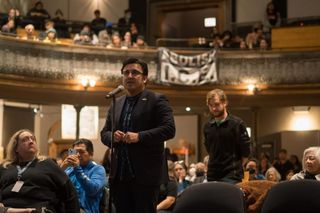
“You have state power—fucking use it. You have far more connections and influence and the ability to actually do what this body is set out to do than anyone here,” said Elena Gormley, a 49th ward resident. “This body is not supposed to be a nice line on your resume.”
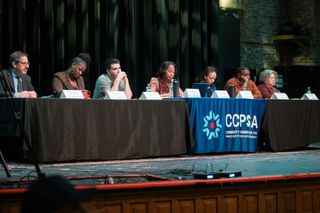
Jazmine Salas, an organizer who helped negotiate the The Empowering Communities for Public Safety Act—the 2021 city ordinance that established the CCPSA—also criticized the commission for policing attendees’ language as the meeting became more raucous.
“This is people’s real fucking lives. And if you as a public servant can’t handle a cuss word or can’t handle someone going slightly over time, then get the fuck out of your seat,” she said.
Chicago Mayor Brandon Johnson and Illinois Governor J.B. Pritzker were not spared from criticism either.
“Over the past seven months, we’ve seen Pritzker allow state police to beat people at Broadview. Brandon Johnson has told us there’s nothing he can do to make CPD intervene to protect legal observers, not that we would ever expect them to,” said Will Oldham, a Rogers Park resident.
The first major incident last year to raise questions over whether CPD illegally aided federal immigration agents occurred in early June, outside the Intensive Supervision Appearance Program (ISAP) office at 2245 S. Michigan Ave. The ISAP program, under ICE’s purview, is an alternative to detention for “low risk” individuals.
On June 4, at least ten participants in the ISAP program received a text message telling them to immediately report to the ISAP office. When they arrived, they were arrested by federal agents.
As word of the arrests spread across social media, outraged community members and elected officials gathered outside the building to protest and demand their release. Multiple police units also responded to the scene.
High-ranking Chicago police officers were seen inside the office conferring with agents. Though CPD made no arrests, their vehicles blocked off traffic as ICE agents left the ISAP office with their captives in white passenger vans.
Chicago police officials would later claim that they did not know immigration enforcement agents were present when they responded. Recordings of the 911 calls obtained by the South Side Weekly contradict these claims.
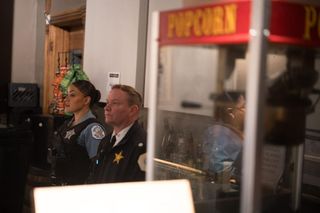
On June 30, City Council’s Committee on Immigrant and Refugee Rights held a hearing about the incident outside the ISAP office. Much of the hearing was consumed debating which of the city’s oversight and accountability agencies would conduct a probe, with no clear resolution.
Chicago Alderpersons Andre Vasquez and Jesse Fuentes both introduced ordinances in September that would designate the Civilian Office of Police Accountability (COPA) as the primary agency responsible for investigating future complaints against members of the police department alleging violations of the Welcoming City Ordinance. Fuentes’ ordinance has been referred to the Joint Committee on Police and Fire and Immigrant and Refugee Rights, while Vasquez’s has since been relegated to the Rules Committee.
Vasquez, who chairs the city’s immigrant rights committee and attended the meeting Thursday night, also reminded the CCPSA that they have not yet held a hearing on that day in June in the 218 days since.
“You can’t ask an agency for evidence of misconduct and expect them to give it to you,” Vasquez told the commission.
Shortly after Labor Day, President Trump and the Department of Homeland Security (DHS) launched a large-scale assault on the greater Chicago area—the so-called Midway Blitz. Roving federal forces met resistance nearly everywhere they went over the following two months. Residents would gather and protest wherever the agents were caught out in the open, at times leading to tense standoffs. On more than one occasion, agents attacked bystanders and rapid responders with chemical weapons.
One major such confrontation occurred on October 4 in the heavily Latine Brighton Park neighborhood. Earlier that day, Border Patrol agent Charles Exum fired five shots into a vehicle on the 3900 block of South Kedzie, wounding 30-year-old Marimar Martinez.
“I fired 5 rounds, and she had 7 holes. Put that in your book boys,” Exum wrote in a text message after shooting Martinez, who was charged with assaulting a federal officer after she was shot. Prosecutors later dropped the case.
As word of the shooting spread, a crowd of angry neighbors came out to protest the federal agents who had assembled on the block. During the standoff, Chicago police officers formed a security perimeter between the protesters and the federal agents.
For their trouble, the police were tear gassed alongside the crowd as the feds made their getaway.
Three weeks later, on October 23, Border Patrol agents encountered several dozen angry residents following an arrest in Little Village near the intersection of 27th & Whipple. In agents’ body-worn camera footage made available to the public by a federal judge, CPD can be seen communicating with the feds and blocking off traffic.
And on December 17, Chicago police pulled over Omar Luna, who had been livestreaming CBP chief Gregory Bovino’s location to Facebook as his Border Patrol caravan headed up Lake Shore Drive that day. Video of the incident shows him carefully following at a safe distance, and no ramming or collision of any kind.
Via translator at Thursday’s hearing, Luna recalled being prevented from continuing north by a Chicago police officer:
“The Chicago Police Department was after me, but they had stopped the whole caravan that was following me, and that is why we are sure that Chicago Police Department is working with them.”
According to audio logs obtained by the Chicago Tribune, a Border Patrol agent called 911 for assistance as their caravan traveled Lake Shore Drive that day, claiming the vehicles following them acted “as if they’re trying to run us off the road here.”
The 911 dispatcher reportedly told the agent that “help is on the way.”
Another video of the same scene recently obtained by Unraveled shows three Chicago police units with lights and sirens escorting ten Border Patrol’s SUVs—one with no license plates—north on Sheridan Road. Another police unit appears to hang back and block traffic from following the caravan.
After traveling through the city and reaching suburban Evanston, federal agents were again cleared an exit path that day by Evanston police:
Bovino later thanked both the Chicago and Evanston police departments on social media for “assistance in preventing violent mobs from assaulting our law enforcement officers.”
“Both departments cleared the way for us to continue our enforcement efforts unimpeded,” Bovino added.
About this story
Related Stories
-
Civil rights stories removed from Border Patrol’s website during Black History Month
Historical accounts of women, Black men, and the agency’s deployment against segregationists in the sixties have disappeared from the official Customs and Border Protection (CBP) website.
-
Identified: the El Paso BORTAC crew rampaging through the Midwest
One violent duo in particular, U.S. Border Patrol agents Michael Sveum (EZ-2) and Edgar Vazquez (EZ-17), have been frequently seen alongside former commander-at-large Greg Bovino terrorizing crowds with chemical weapons in Chicago and the Twin Cities.
-
Cook County State’s Attorney has “taken no action whatsoever” against feds, new lawsuit alleges
The suit seeks the appointment of a special prosecutor to investigate potentially unlawful conduct by federal agents in Illinois.