Support Unraveled
Your support funds our investigative and on-the-ground reporting. Thank you for uplifting independent journalism!
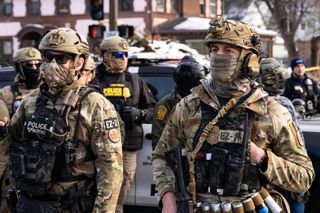
SupportOne violent duo in particular, U.S. Border Patrol agents Michael Sveum (EZ-2) and Edgar Vazquez (EZ-17), have been frequently seen alongside former commander-at-large Greg Bovino terrorizing crowds with chemical weapons in Chicago and the Twin Cities.
by Steve Held Feb 4, 2026
Share this article:
Content warning: this story contains descriptions of police violence.
Editorial note: Unraveled reporters Steve Held and Raven Geary were named plaintiffs in Chicago Headline Club v. Noem.
From California to Illinois to Minnesota, where federal agents have gone, violence and death have followed.
This past fall, masked men in military gear plucked over 1600 people from their lives across Chicago to imprison them in deadly detention centers. A U.S. Border Patrol agent shot a woman five times and later bragged about it. An Immigration and Customs Enforcement (ICE) officer killed Silverio Villegas González in his car after he dropped off his kids at daycare. Another unidentified agent, off-duty, killed a man celebrating New Year’s in Los Angeles (the feds continue to raid and kidnap people across Southern California, even though many news cameras have moved on). Hundreds of people not subject to immigration “enforcement” have also been arrested and criminalized: protesters, community defense volunteers, clergy, and people who simply followed the sound of whistles piercing the air. A few sentences can hardly capture the scope of the lives affected in less than a year.
Customs and Border Protection (CBP) agents, along with their now-former campaign leader, Gregory Bovino, left Chicago in mid-November to maraud through North Carolina and Louisiana over the holiday season (simultaneously, a flood of federal task force traffic stops has continued with little attention in Tennessee). After right-wing propagandist Nick Shirley painted a target on the Somali community via viral videos lobbing false allegations of fraud, another target emerged: Minneapolis-Saint Paul, which also happened to be “ground zero” for anti-police protests following the murder of George Floyd in 2020.
On January 6, Trump announced 2000 federal agents were headed to the Twin Cities, an escalation of federal police activity that had already intensified in the metro in December 2025.
The next day, an ICE agent shot and killed 37-year-old Minneapolis mother, artist, and poet Renée Good. Seventeen days later, two CBP agents then killed 37-year-old nurse Alex Pretti just 1.5 miles away from where Good was shot.
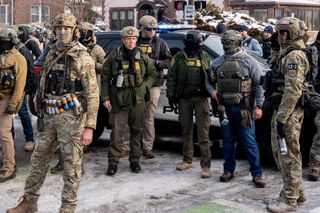
Chicagoans and Minnesotans now share many of the same traumas as a result of federal occupations of the two metros. But in the Twin Cities, with possibly ten times the number of feds dispersed across a smaller area (including other Minnesota cities, just as in the Chicagoland “blitz” that sprawled across several northern Illinois counties and into Indiana), the chances of violent encounters between residents and agents greatly increased.
When CBP arrest teams face crowds of bystanders in the streets, they call upon their Quick Response Force (QRF) for help. Many agents on these QRF teams belong to the Border Patrol Tactical Unit (BORTAC), where agents are allegedly trained to deal with “high-risk operations” such as hostage situations, active shooters, and terrorist threats. The Uvalde, Texas mass shooter was killed by BORTAC agents.
One group of BORTAC agents from El Paso, Texas has been recorded repeatedly attacking people with chemical weapons in both Chicago and Minneapolis. Two have only been known by their identification patches: “EZ-2” and “EZ-17.”
Based on an analysis of publicly available CBP incident reports and over 70 hours of body-worn camera (BWC) videos released by a federal judge in November, Unraveled has identified EZ-2 and EZ-17, along with some of the other agents present at notable incidents.
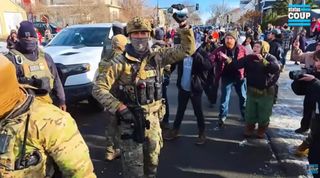
In a video published yesterday by Unicorn Riot, the pair can be seen front-and-center during a protest outside the Whipple Federal Building on January 15.
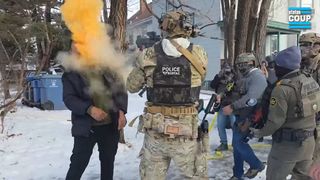
Unraveled has identified the agent on the left firing the launcher as Edgar E. Vazquez, 39, wearing the identification patch “EZ-17.” On the right, blasting the pepper spray, is supervisory agent Michael B. Sveum, 41, known as “EZ-2.”
Vazquez began to draw increased public attention as images of him went viral after shooting a man in the head with a chemical munition on the day Renée Good was killed.
Open source investigators with Bellingcat performed an extensive analysis of this incident. They found that Vazquez fired his 40mm launcher at people five times within five minutes on January 7:
At the same scene, Michael Sveum doused people with pepper spray and deployed tear gas.
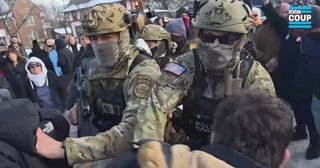
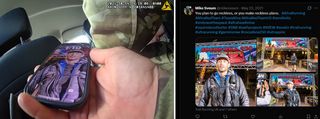
Unraveled identified Sveum by reviewing his body camera video from an incident in Chicago’s East Side neighborhood on October 14, 2025.
Sveum’s equipment is marked with the initials “MS.” He is one of only two agents present with those initials, and his actions that day match those described in reports he authored. His identity was further confirmed by the lock screen on his phone, captured on BWC video. It shows a photo from an Arizona ultrarunning event he also posted to social media in 2021.
Sveum’s report identified the other agents he was riding with during the same incident, which includes Vazquez. His BWC video shows him riding with agents identified as “EZ-17,” “EZ-13,” and another agent without a visible identification number.
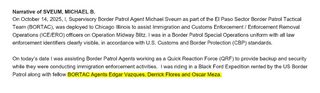
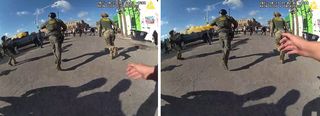
Vazquez’s report from the same incident describes “providing security” for officers making an arrest after a man threw a smoke grenade back at agents. This description matches the same arrest and time of day, where “EZ-17” is seen standing guard. His identity was further confirmed through a similar analysis of reports and video from an October 23 incident in Little Village, which also shows “EZ-17” taking actions that match those described by Vazquez.
![On the left is a report excerpt from Vazquez reading:
At approximately 11 :45 A.M, after multiple commands by all agents for protesters to get off the street to make room for a government vehicle, an Office of Field Operations Special Response Team Officer deployed a pocket smoke cannister in response to the large crowd starting to shove and push agents in the street. Once deployed, a subject in a blue hoody grabbed the pocket smoke and threw it back in the direction of the Agents/Officers. This subject was later identified as [redacted].
While multiple other agents went into the crowd to arrest the subject who threw the smoke cannister back at us, I placed myself between the agents and the crowd to provide security for them. After a brief struggle, agents were able to put [redacted] into handcuffs and tell him he was being arrested for assault. The subject was walked to a government rental vehicle to be transported to the Federal Bureau of Investigations Office to be interviewed regarding the assault.
On the right is a frame from another agent's body camera footage showing agent EZ-17 standing at alert with his launcher raised ready to fire as two agents, one of them Michael Sveum, arrest a man they wrestled to the ground.](/assets/images/3mG7gqrMJ4-320.jpeg)
On January 7, ICE agent Jonathan Ross killed Renée Good as she observed agents on patrol. As word of the fatal shooting spread, residents showed up at the scene.
Video livestreamed by independent news outlet Status Coup shows federal agents—primarily Vazquez and Sveum—shoving residents to the ground, firing chemical munitions at people at close range, and deploying CS gas (tear gas). The so-called “less lethal” munitions used by the feds—and other police forces—have resulted in serious injury and deaths, particularly when aimed at people’s heads.
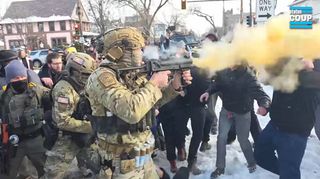
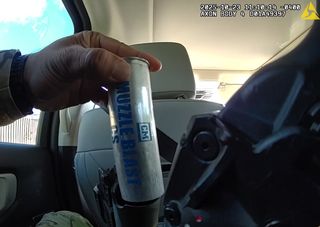
The bright orange cloud exploding from the launcher has the same appearance as cartridges fired by Vazquez in Chicago, where he reported firing a 40mm Muzzle Blast CS cartridge. The munition disperses the same powder used to create tear-gas in a concentrated powder form.
Moments later, the agents try to move a car through the crowd, when Vazquez fires his launcher at another person’s head. By the time the agents departed, Vazquez had fired at least four chemical rounds directly in people’s faces. Sveum then pepper sprays a group of people standing in the road before Vazquez shoves several of them out of the way. Once the vehicle has a clear path, Sveum lobs a gas canister into the crowd as they make their exit.
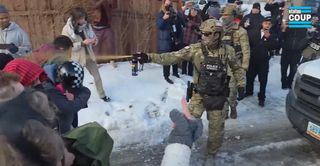
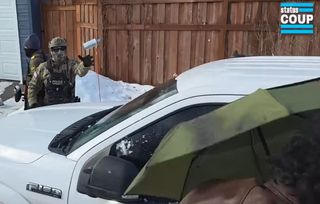
The CBP use of force policy clearly prohibits targeting “the head, neck, groin, spine, or female breast” with projectiles and limits their use to subjects “offering active resistance.”
According to their reports, both agents have completed months of rigorous BORTAC training, as well as the Border Patrol Search, Trauma, and Rescue (BORSTAR) program, emergency medical training, and specialized tactics on crowd control and civil unrest. Sveum is also trained to execute vehicle pursuits, while Vazquez is qualified as a firearm instructor:
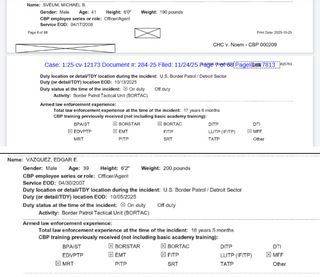
Vazquez has been with Border Patrol since 2007; Sveum since 2008.
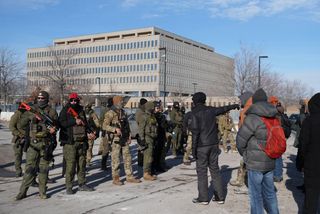
On January 11, Vazquez was seen immediately after a group of agents marched out of the Whipple Federal Building to fire a barrage of pepper balls and pepper spray at protesters.
On January 12, he was also seen assisting with the arrest of a young boy.
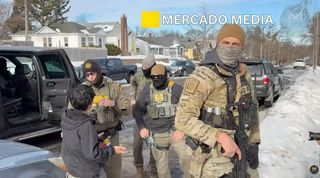
Both Sveum and Vazquez were at the scene of another incident just twenty minutes later where agents deployed tear gas and pepper balls against residents.
Minneapolis right now— At 35th and Park, a crowd has gathered after a car crash involving the feds. Agents just launched tear gas and pepper balls at people.
— unraveled (@unraveledpress.com) January 12, 2026 at 12:37 PM
[image or embed]
On January 13, Vazquez and Sveum were spotted with Bovino’s caravan at a gas station stop. The group went on to canvas parts of the Midway neighborhood block-by-block looking for people to arrest.
We haven't seen any detentions so far. Feds lined up for a pit stop in this Speedway.
— unraveled (@unraveledpress.com) January 13, 2026 at 1:08 PM
[image or embed]
Both agents were also seen on January 14 traveling in an armored vehicle before agents blanketed the neighborhood in a hail of flash bangs, chemical gas, and other munitions.
During Border Patrol’s occupation of Chicago in the fall, members of the El Paso BORTAC unit were present at two significant and violent escalations by CBP. One occurred in Little Village, and the other in the East Side neighborhood.
On October 23, a crowd of at least 75 angry neighbors gathered outside a discount mall where Border Patrol agents were making arrests. Bovino, accompanied by at least one Department of Homeland Security (DHS) helicopter and more than two dozen heavily armed agents, ultimately fired projectiles and deployed gas against the heckling crowd.
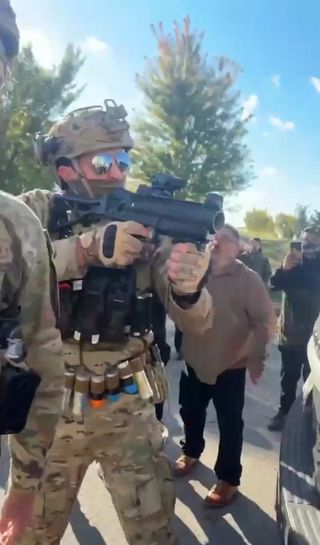
Unraveled has identified additional members of the El Paso BORTAC unit present that day as Bryan Belen Lleras, 32, Chad B. Hickman, 50, and Oscar A. Meza, 36.
Belen, Hickman (EZ-9), and Meza (EZ-13) joined CBP in 2017, 2000, and 2008, respectively.
Witness video shows Bovino tossing a gas canister into a crowd in defiance of a temporary restraining order. In November, a federal judge determined that Bovino lied about being hit by a rock before he threw the canister. Agents also claimed residents threw fireworks at them, but the only explosives observed on video appear to be flash grenades thrown by agents themselves.
Vazquez and Meza each reported firing a 40mm “muzzle blast” CS round at people gathered outside the discount mall. Vazquez also reported throwing a smoke grenade.
No video from Vazquez’s camera was available, and Meza’s videos exclude a twelve minute window during the time he fired his weapon. Hickman’s camera, however, captures Meza firing. Vazquez follows with a smoke canister.
Nine days earlier, on October 14, other Border Patrol agents from an unknown sector chased a car that they say rammed them after they tried to block it in to perform what they termed a “consensual encounter.” The resulting high-speed pursuit ended near 105th Street and Avenue N in the East Side neighborhood, when agents crashed into the rear of the car. Again, a crowd began to gather as neighbors emerged from homes and word spread on social media.
Border Patrol put out a call for agents to assist. Sveum, Vazquez, and Meza—riding with 36-year-old fellow El Paso BORTAC agent Derrick J. Flores—arrived twenty minutes later.
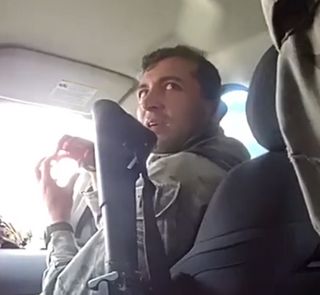
Before long, BWC footage shows at least 100 residents crowd along the perimeter, shouting at agents. The first hour goes by without incident, until agents attempt to push neighbors out of the street. An agent detonates a smoke canister, which a man lobs back, over agents’ heads.
Sveum and two other agents wrestle the man to the ground as Sveum shouts, “That’s assault! That’s assault!”
They place the man under arrest as Vazquez stands between them and the crowd with his launcher. Other agents transport the man to the FBI building while Sveum’s team remains.
As they don gas masks in preparation of gassing the crowd with CS gas, Sveum says to Flores, “Dude, this shit just motivates me.”
Flores laughs, “A little bit…a little bit.”
“It’s like, dude, we’d have been out of here an hour ago if you wouldn’t be assholes,” Sveum laments. “We’re gonna be the last guys here, you might want to get you a mask.”
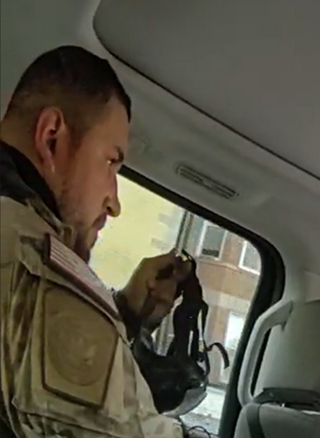
Another 35 minutes pass before two other agents lob at least seven tear gas canisters into the crowd. As gas fills the area, Flores sits in the driver’s seat of their SUV with a mask on. In the backseat sits another man they arrested—allegedly for throwing a tear gas canister back at agents.
The man, arms handcuffed behind his back, chokes on the gas as it seeps into the SUV.
“Holy shit! Please!” he pleads.
“Relax,” Flores replies. “They expose us to this shit all the time. You’ll be fine.”
The man continues gagging and coughing. As the other agents pile into the car, Flores says: “You’re fine. Relax. You can breathe, trust me.”
Just before leaving, Vazquez reported firing a 40mm muzzle blast CS cartridge at a person who allegedly attempted to kick a gas canister. This moment does not appear on any available videos.
The agents then drive their arrestee from the East Side to the FBI field office at 2111 W. Roosevelt Road in the Near West Side. The trip takes over an hour because Vazquez selects an address in Wheaton, Illinois, instead of Chicago. The agents only realize their error after arriving at their destination 28 miles west of the FBI office.
Your support funds our investigative and on-the-ground reporting. Thank you for uplifting independent journalism!
SupportAccording to CBP reports, Vazquez, Meza, and Flores arrived in Chicago on October 5, the day after Border Patrol agent Charles Exum shot a woman in the Brighton Park neighborhood.
Sveum’s first day in Chicago was the day before the East Side crash.
During the East Side incident, Sveum frequently chatted with other agents and poked fun at people in the crowd. When one Black woman was lobbing “racially tinged” insults at white agents, Sveum approached Flores, who Sveum describes as Black to another agent, and suggested he go stand in front of her to see what she said. Flores did so and Sveum proceeded to tell agents about how funny this was.
On more than one occasion that day, Sveum joked with agents that the real problem is the “females” who get the “dudes” riled up.
Sveum, an ultra-endurance athlete, has used his public (now private at the time of publication) Instagram page to post videos of himself and other agents conducting exercises alongside videos of his personal athletic pursuits.
One video shows what appears to be a winter training mission with militarized gear. It is unclear if this is an official CBP activity:
Another video he shared shows agents joyriding on ATVs along a section of the border wall:
BORTAC was formed in 1984 to address “rioting” in detention centers run by ICE’s predecessor, Immigration and Naturalization Services. The unit’s mission and scope quickly expanded during the 1980s to include joint-missions with the Drug Enforcement Agency in South America. In 1992, BORTAC was deployed to Los Angeles in the wake of the Rodney King trial. It was also BORTAC who led the raid on the home where Elian Gonzalez was living in 2000, before he was returned to Cuba.
After 9/11, BORTAC continued to expand its scope, supporting joint-operations and training with both domestic and foreign police forces.
In 2020, BORTAC was deployed to quell Black Lives Matter protests in Portland after George Floyd’s killing by Minneapolis police. At the time, Oregon Attorney General Ellen Rosenblum accused federal agents of escalating tensions by using tear gas and other chemical munitions against protesters—and using unmarked vehicles and unidentifiable agents to arrest them.
That same year, the ACLU found that BORTAC had been deployed in Texas with authorization to use deadly force against anti-police protesters during George Floyd’s funeral, which took place outside of Houston.
At the time, Shaw Drake, policy counsel of the ACLU of Texas Border Rights Center, observed: “CBP is the largest law enforcement agency in the country, and also the least accountable. It’s disturbing to see they made preparations to tear gas or kill people who were mourning another death at the hands of police. CBP has no place in our communities, period.”
BORTAC is based out of El Paso, Texas, a city of 680,000 residents, sitting on the Rio Grande across from Ciudad Juárez.
El Paso is a major hub for both CBP and ICE. The nation’s largest immigration detention camp, which holds more than 2,700 detainees, is located at the Fort Bliss military base in El Paso. Captives there have reported horrific conditions and violence, including beatings, sexual abuse, and clandestine deportations.
According to a Project on Government Oversight (POGO) analysis of CBP records, the El Paso Sector has the second highest reports of use of force by agents. POGO’s report notes that on average CBP reports about double the number of uses of force compared to assaults on officers, however, CBP’s incident reports show how these numbers are manipulated.
It is unclear if Sveum, Vazquez, and other members of their El Paso BORTAC unit remain in Minnesota, or if they returned home after Bovino was relieved of his command over the Twin Cities operation.
DHS has not responded to our request for comment on our investigation.
Raven Geary contributed to this reporting.
Minneapolis photographer Chad Davis has been documenting the federal occupation of the Twin Cities since December 2025. More of his work can be found here.
On November 20, 2025, in the case of Chicago Headline Club v. Noem, Judge Sara L. Ellis of the U.S. District Court for the Northern District of Illinois released the CBP reports and over 70 hours of body-worn camera videos she relied on in her ruling published the same day. These records cover CBP uses of force in the Chicago area from September and October.
CBP’s incident reports include the full names, ages, height, weight, services dates, and training completed by agents present. The reports included uses of force, alleged assaults against the agents, arrests, and narrative descriptions of each incident. These details enabled us to identify agents and their actions in CBP’s videos.
Note: The Pacific Antifascist Research Collective first publicly identified Michael Sveum in a post to social media site Bluesky on January 14. Unraveled independently verified his identity separately and without collaboration while analyzing the reports released by DHS in November.
Chicago Police Superintendent Larry Snelling defended his officers’ actions amid the Trump Administration’s mass deportation campaign in Chicago, waving off community criticism as people not having an “open mind.”
Retired Chicago police sergeant Lee Bielecki’s snooping at the home of a member of the Community Commission for Public Safety and Accountability is part of a pattern of intimidation and attempts to influence the nomination process for the commission, activists and police district councilors say.
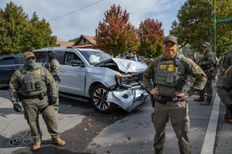
DHS claimed federal agents intentionally hit a fleeing vehicle to try to stop the driver in Chicago’s East Side neighborhood last October—but videos of the 18-minute high-speed pursuit show they actually blew a tire and crashed after ignoring a supervisor’s commands to end the chase.