Support Unraveled
Your support funds our investigative and on-the-ground reporting. Thank you for uplifting independent journalism!
SupportDHS claimed federal agents intentionally hit a fleeing vehicle to try to stop the driver in Chicago’s East Side neighborhood last October—but videos of the 18-minute high-speed pursuit show they actually blew a tire and crashed after ignoring a supervisor’s commands to end the chase.
by Steve Held Mar 26, 2026
Share this article:
On the morning of October 14 of last year, organizer Oscar Sanchez was in Chicago’s City Hall, preparing to deliver public comment on a stalled environmental justice ordinance, when his phone started blowing up with texts: Border Patrol was in the East Side neighborhood of Chicago. There was a car crash. People were angry and scared.
“I know we came here for one thing, but I think we gotta head back,” recounted Sanchez.
The day fell roughly at the midpoint of President Donald Trump’s so-called “Operation Midway Blitz.” Thirty-three days earlier, Immigration and Customs Enforcement (ICE) agents shot and killed Silverio Villegas González—and just ten days prior, a Border Patrol agent shot Marimar Martinez five times. Chicagoans were on alert and on edge.
Sanchez rushed back home to get to the scene. He said his first priority was de-escalation, and to ensure that people recorded the agents’ actions.
“We were just trying to set a tone of hey, we’re here, and let’s make sure that we prove everything that’s happening, because they’re going to try to lie,” said Sanchez.
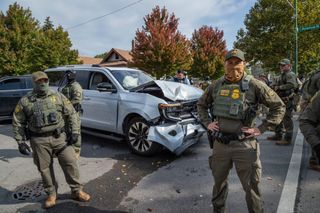
At the time, local and national media outlets published the Department of Homeland Security’s (DHS) claim that the crash was an intentional, controlled decision by Customs and Border Protection (CBP) agents who initiated an “authorized precision immobilization technique,” or PIT maneuver, to stop a fleeing vehicle.
An Unraveled analysis of publicly available CBP incident reports and over 70 hours of body-worn camera (BWC) videos released by a federal judge in November appears to tell a very different story, however. Video shows that agents ignored direct orders from a supervisor to stop the pursuit, and that the crash was not the result of an authorized PIT maneuver—rather, the agents blew a tire immediately before crashing. The chase was also more dangerous than previously understood, extending over 18 minutes with both cars speeding through stop signs without lights or sirens.
Following the crash, one of the involved agents also pointed his service weapon at bystanders in a nearby Walgreens. He claimed men in the store “charged” at him, though video of the incident shows otherwise.
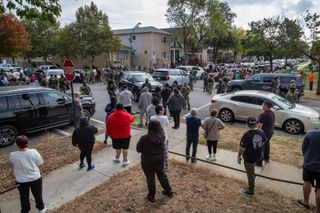
According to CBP records, around 10:15 a.m. on Tuesday, October 14, Border Patrol agents Benito Nunez, Carlos Chavira, Jr., and Jesus Guillen pulled their vehicle in front of a red Ford Explorer parked outside of a business at 3004 East 100th Street.
Agents claimed they attempted to initiate a “consensual encounter” with the occupants because they felt it was “suspicious” that they were parked outside of a store that was not open.
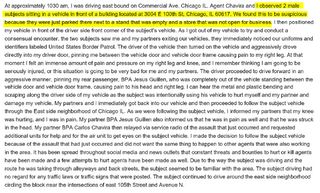
The report written by Agent Nunez appears to contain several errors. Commercial Ave is a north-south road, and video shows the chase already underway at 10:17 a.m. The business, which appears to be Eagle Food and Liquor Market, opens at 7:00 a.m. on weekdays. Store employees confirmed to Unraveled they were open at the time.
In his narrative, Nunez also repeats unfounded rumors that “bounties to hurt or kill agents” had been issued. He says that upon seeing their uniforms, the driver “aggressively drove directly into my driver door, pinning me between the vehicle door and vehicle door frame.”
According to Nunez, the SUV continued to drive forward, also pinning Agent Guillen between the back passenger door and the car frame. Guillen reported thinking “at the very least” he was going to “lose a limb” from the impact.
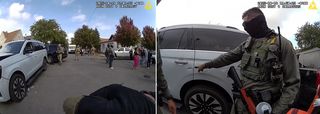
Video of the agents’ car following the crash shows no apparent damage to the driver’s door, and a scrape on the rear passenger door.
The initial stop and the alleged assault were not captured because agents failed to activate their cameras until they had already been in hot pursuit for at least two miles.
Early in the pursuit, one of the agents shouts, “PIT him, PIT him, PIT him!”
“I’m not certified, bro,” replies Nunez, who was driving the rented Ford Expedition. “Ask ‘em if I can PIT—but tell ‘em I’m not certified.”
Guillen, riding in the back seat, relays the request several times, but never receives authorization.
Minutes into the chase, one of CBP’s helicopters, callsign “TROY,” tracks the fleeing vehicle and reports its location to agents. The agents continue to closely pursue the vehicle and then change tactics to try to get in front of the SUV to deploy Stop Sticks. Much of the chase involves the fleeing vehicle leading the agents in circles around East 105th Street and South Avenue N.
Another federal vehicle, a Black Chevy Tahoe outfitted with lights and sirens, briefly joins the pursuit about 14 minutes into the chase.
Approximately 15 minutes into the pursuit, the team’s supervisor, CBP agent Alberto Gonzalez, Jr., orders the agents to stop following. He is also in the neighborhood by this time, riding in a different vehicle.
“He said stop following,” Guillen says.
“No, he hit two agents, bro,” replies Chavira from the front passenger seat.
Gonzalez attempted to order the agents to call off the chase several more times over a handheld radio and his phone.
“I already fucking told them, dude,” Gonzalez remarks after he realizes they have not stopped. “ST6 [Strike Team 6], stop following that vehicle!”
A few minutes after the orders to terminate, the agent’s SUV strikes a curb, blowing the front left tire.
Chavira looks at Nunez, “We got a flat?”
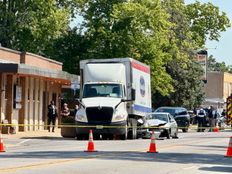
Nunez accelerates on the flat tire, crashing into the rear of the red Explorer. The instant before the crash, the speedometer reads 51 mph as Nunez appears to swerve into the car braking in front of them.
As other CBP agents arrived on the scene, Border Patrol supervisory agent Michael Sveum asked Nunez about the crash. Nunez described it as an unavoidable collision because he could not brake fast enough on a flat tire.
“We were chasing him… I hit my tire on the corner… I was just hitting my brake. He brake checked me at this intersection and I swerved and…” Nunez claps his hands together indicating the crash.
Nunez gave a similar explanation to supervisory agent Gonzalez. In the middle of his explanation, Gonzalez points to his BWC, seemingly to caution the agent.
Nunez wrote virtually the same description in his official report on the accident.
“I hit a curb with my front driver’s side tire causing the tire to lose air… the subject vehicle instantly applied the brakes causing me to immediately engage my brakes and swerve. As a result, I collided with the driver side rear bumper of the subject’s vehicle,” Nunez wrote
Supervisory agent Gonzalez appears to have tried to downplay the agents’ actions in his report, writing that the agents “followed” the fleeing vehicle, but were unable to “pursue” because they were in a rental vehicle without lights and sirens.
He does not mention that he ordered them multiple times to terminate the pursuit.
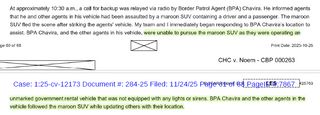
The following day, DHS issued a statement which contradicted the agents’ accounts and BWC video. The federal agency described the collision as an “authorized precision immobilization technique (PIT) maneuver,” a tactic police use to intentionally disable a fleeing vehicle.
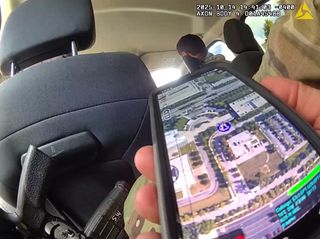
During the entire chase, other CBP agents and leadership were able to track the exact position of the pursuit vehicle on a map using ATAK, or the Android Team Awareness Kit. ATAK is an app frequently used and referenced on agents’ BWC videos that allow them to see where other agents and teams are located in real-time:
All three agents involved in the crash have been with the agency less than four years. Unraveled is listing their ages as written in the October 2025 report.
Nunez, age 30, joined CBP in March 2023.
Chavira, 35, started with CBP in September 2022 and Guillen, 35, joined in May 2022.
45-year-old supervisory agent Gonzalez has been with CBP since December 2003.
A San Francisco Chronicle analysis of government data found that at least 1,377 people were killed as a result of police pursuits in the U.S. in 2020 and 2021. Between 2017 and 2022, the number killed exceeds 3,336. More than 52,600 people were injured.
The Chronicle found that more than a quarter of all people killed in police pursuits were bystanders; chases disproportionately harmed Black people, who were killed at a rate four times as high as white people; and most police pursuits were initiated over traffic violations and nonviolent crimes such as shoplifting.
Your support funds our investigative and on-the-ground reporting. Thank you for uplifting independent journalism!
SupportAt least 22 people were killed during pursuits initiated by Chicago police between 2017 and 2022, according to data published by The Chronicle. According to a WTTW report published last week, police pursuits have cost Chicago taxpayers at least $103.1 million since January 2025 to resolve lawsuits stemming from injuries and deaths. That total does not include a proposed $27 million settlement in a case where Chicago police allegedly tried to cover-up a police pursuit that killed 47-year-old Stacy Vaughn-Harrell.
The Chicago Police Department prohibits the use of PIT maneuvers, while departments such as the Los Angeles Police Department and California Highway Patrol limit the use of this offensive driving technique to speeds under 35 mph. During the Biden Administration, CBP’s pursuit policy prohibited the use of PIT maneuvers; however, President Donald Trump rescinded that policy in January 2025.
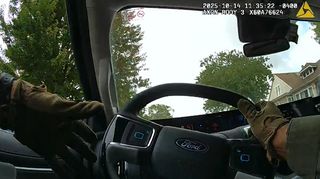
According to CBP’s use-of-force policy, an intentional vehicular impact at “excessive speeds” is defined as the use of deadly force. Most police departments restrict the use of PIT maneuvers and other tactics that involve physical contact between vehicles to speeds below 35 to 40 mph. Nunez’s speedometer read 51 mph just before the crash.
According to CBP’s pursuit policy that was in effect at the time: “The use of emergency lights and siren is mandatory when in pursuit or taking exemptions to traffic signals, stop signs or prescribed direction of travel.”
The policy requires pursuing agents and their supervisor to be certified in offensive driving techniques, and to weigh the danger to the public presented by the fleeing individual versus the “immediate danger to the public of continuing the emergency driving or vehicle pursuit (i.e. proximity of population centers, pedestrians, schools, traffic flow, etc.).” The policy also advises agents to consider other factors such as the presence of air support.
CBP issued a new pursuit policy just 12 days after this incident, which retains all of the above considerations.
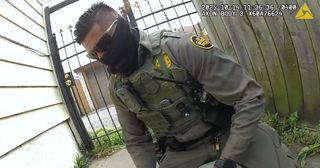
Geoffrey Alpert, a professor of criminology and criminal justice at the University of South Carolina, has worked with local and federal law enforcement on crafting use-of-force and pursuit policies for decades.
He explained that the purpose of air support is to minimize risk on the ground.
“When you have air support, why are you chasing?” said Alpert. “It’s more likely than not, when you quit chasing, the suspect will quit fleeing. So the whole point of air support is to avoid a dangerous ground chase.”
Alpert described the decision to pursue as a constant balancing act.
“You look at the government’s interest in apprehension. In other words, what did this guy do? Did he kill someone? And the other side of the coin is risk. If you’re going 100 miles an hour, the risk is more than if you’re going 30 miles an hour. […] When is a PIT maneuver safe? We don’t have the data. We don’t know. The slower the speed, the more safe it is,” he said. “Maybe it’s like a Corvair—unsafe at any speed. When you ram someone with a 4000 pound vehicle, it’s likely to cause serious injury or death.”
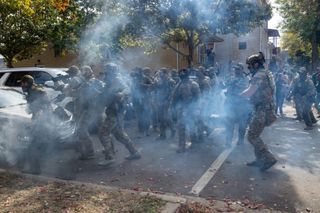
Following the chase, the crash occurred at the intersection of East 105th Street and South Avenue N. Immediately after impact, the two occupants of the red Explorer jumped from their car and ran in different directions.
Nunez and Guillen sprinted after the car’s driver, while Chavira chased the passenger. Nunez caught up with the driver and arrested him about two blocks away as he tried to jump a fence. Chavira chased the passenger to a Walgreens about three blocks away.
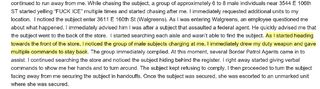
Inside the Walgreens store, Chavira points his firearm at bystanders gathered three or four aisles away. The men shout at Chavira, with one seemingly recording on his phone. Chavira reported that he pulled his sidearm because the group was “charging at me.”
After agents arrested both occupants, the driver was transported by ambulance to a hospital. CBP reported that both individuals were placed into FBI custody.
All three agents returned to the scene of the accident where a crowd had gathered. Agents Guillen and Nunez both reported minor injuries from the alleged assault, and Guillen reported injuries from the crash, but all three declined examination by Emergency Medical Services personnel at the scene.
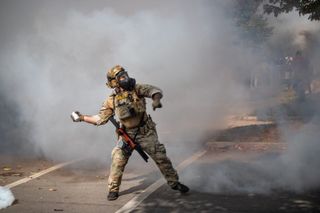
Chavira reported throwing a smoke grenade into the crowd of neighbors who had gathered about 45 minutes before other agents tossed at least seven tear gas canisters—four of which are the “triple chaser” variety which explodes into three separate canisters spewing CS gas.
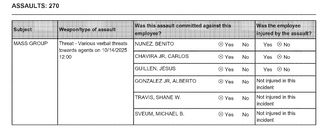
CBP reported an alleged 270 assaults against federal agents took place in the East Side that day after the vehicle crash. This includes “various verbal threats.”
Sanchez said he’s heard from residents who suffered from the effects of the chemical gas for days afterwards.
“The 10th Ward is within the 94th percentile of the worst respiratory health in the state of Illinois,” he explained. “There’s many members that we knew of, afterwards, having trouble breathing. They [Border Patrol] did what they did because they wanted to scare us, so people say I don’t know if I can be involved, because I’m scared this is going to kill me.”
Residents of the East Side neighborhood—and the entire Southeast Side of Chicago—have battled the health effects of widespread air pollution since the industrialization of the Calumet region began in the late 19th century. Overlapping layers of industrial toxins ranging from heavy metals to black dust (petcoke) blowing in the wind have afflicted the community with significantly higher rates of asthma, autoimmune disease, and other chronic health conditions.
Sanchez said he would like to see accountability, but is skeptical that anyone is investigating incidents like this one in his neighborhood.
“We need accountability when it comes to aggressive tactics against the community,” he said. “We’re told that they’re going to do their investigation, but do we still trust the same government that’s lying about what they’re doing to also be in charge of the investigation of their own people? We don’t.”
The Department of Homeland Security did not respond to our questions about their initial narrative of events on October 14. Unraveled cannot confirm if any investigation was opened into the involved officers.
Editorial note: Unraveled reporters Steve Held and Raven Geary were named plaintiffs in Chicago Headline Club v. Noem.
Historical accounts of women, Black men, and the agency’s deployment against segregationists in the sixties have disappeared from the official Customs and Border Protection (CBP) website.
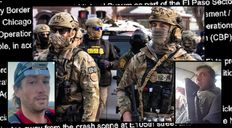
One violent duo in particular, U.S. Border Patrol agents Michael Sveum (EZ-2) and Edgar Vazquez (EZ-17), have been frequently seen alongside former commander-at-large Greg Bovino terrorizing crowds with chemical weapons in Chicago and the Twin Cities.
The suit seeks the appointment of a special prosecutor to investigate potentially unlawful conduct by federal agents in Illinois.